
LIGHTHOUSE MINDSPARK CONTEST: A complete mental ability test
Information and Guidelines for Students, Parents and Schools
Our purpose
To help learners recognize their strengths, explore different ways of thinking and identify areas where further learning and support may be useful. The contest is intended to encourage growth—not to label, rank or limit a child’s potential.
1. What is the Lighthouse Mind Spark Contest?
The Lighthouse Mind Spark Contest is a grade-wise mental ability assessment designed for students from Grade 4 to Grade 12. It uses age- and grade-appropriate activities and questions to explore a range of thinking and learning skills. Separate papers are prepared for each grade, with difficulty progressing across grades. Assessment materials may be provided in English and Hindi, as announced for the relevant administration.
The assessment is educational in nature. It is not a clinical, psychological or medical diagnosis, and it should not be treated as a standardized IQ test, a school examination, or the sole basis for decisions about a student’s future.
2. Purpose and expected benefits
· Help students reflect on strengths such as reasoning, observation, memory, problem-solving and creative thinking.
· Encourage curiosity, confidence, independent thinking and a positive attitude towards learning.
· Give parents and teachers discussion points for supporting a student’s learning and development.
· Help schools identify broad areas where enrichment activities, practice or additional support may be useful.
· Provide a structured opportunity for students to attempt varied thinking tasks in a supportive setting.
3. Who can participate?
The assessment is intended for students in Grades 4–12. Each student should attempt the paper assigned to their current grade, unless the organiser or school provides different written instructions. Schools should confirm eligibility, dates, venue, language options and any applicable participation arrangements before the test.
4. Syllabus and skills covered
This is not a subject-based syllabus like mathematics, science or social studies. It focuses on general mental abilities and thinking processes. The exact question mix may vary by grade.
· Verbal and language reasoning: understanding words, relationships, statements and simple written information.
· Logical reasoning: identifying rules, drawing conclusions, sequencing and solving logic-based problems.
· Numerical reasoning: number patterns, numerical relationships and age-appropriate quantitative thinking.
· Visual and spatial reasoning: shapes, figures, rotations, patterns and visual relationships.
· Pattern recognition and observation: spotting similarities, differences, sequences and missing elements.
· Memory and attention: recalling information, noticing details and following instructions.
· Creative thinking: generating ideas or considering more than one possible approach, where included in the paper.
· Situational thinking: considering everyday situations and selecting or explaining a reasonable response, where included.
· Interests or self-reflection prompts: where included, these are intended to support reflection and are not right-or-wrong judgements about a child’s personality.
Preparation note: Students do not need to memorize a textbook or learn a special set of answers. Regular reading, puzzles, age-appropriate number activities, observation games and restful routines can help build confidence. The test should not require expensive coaching or paid preparation material.
5. Test format and administration
· A separate assessment paper is prepared for each grade from Grade 4 through Grade 12.
· The planned assessment structure uses a total of 100 marks per paper. Any grade-specific variation will be stated in the instructions accompanying that paper.
· The test may include different question styles, such as multiple-choice, short response, pattern-based or activity-based items, depending on the grade and paper.
· The duration, start time, language choice, permitted materials and submission procedure will be communicated by the school or organizer before the assessment.
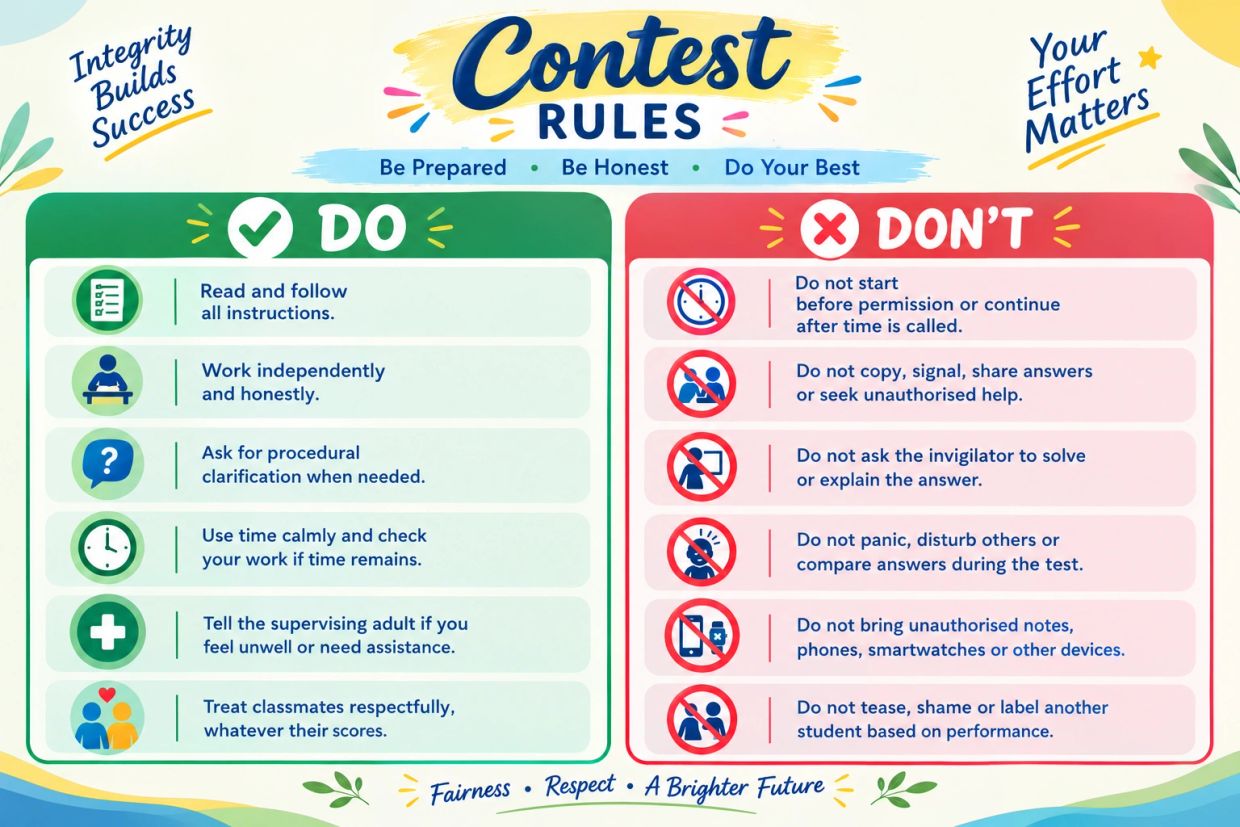
· Students must follow the instructions printed on their paper and those given by the authorized invigilator.
· If a question or instruction is unclear, students should raise their hand and ask the invigilator for procedural clarification. Invigilators must not reveal or suggest an answer.
6. Instructions for students
· Arrive on time and bring only the materials permitted by the school or organizer.
· Write your name, grade and any requested identification details clearly in the designated spaces.
· Listen carefully to all instructions before beginning.
· Read each question fully. Manage your time sensibly and move on if a question is taking too long, if the format permits.
· Attempt the paper independently and honestly. Do not copy, communicate answers or use unauthorized devices or resources.
· If you make a mistake, follow the correction method stated on the paper. Keep your work neat and legible.
· Stop writing when instructed and submit all required pages or materials.
· Remember: one test is only a snapshot of performance on that day. It does not define your intelligence, worth or future.
FAQ's & CONTACT INFORMATION
Frequently asked questions
Is this a school subject examination?
No. It focuses on general thinking and mental ability skills rather than testing the full school curriculum.
Do students need coaching?
No special coaching is required. Familiarity with puzzles, reading, patterns and age-appropriate reasoning activities may help students feel comfortable.
Does the test measure IQ or diagnose a learning condition?
No. It is an educational mental ability assessment, not a standardized IQ test or a diagnostic tool.
What if a student performs poorly on the day?
A single result does not define the student. Consider the testing context and use feedback constructively.
Who should answer questions about the date, duration, registration or results?
The participating school or the official contest organizer, using the contact details communicated for that administration.
Official information and contact
For the current schedule, registration details, grade-specific instructions, results process or other queries, please refer to the official communication issued by the participating school or Lighthouse Mind Spark Contest organizer.
HELPLINE NUMBER : +91-9429692906
WHATSAPP: +91-9634676724
PRIZE DISTRIBUTION BY :
AMAR UJALA NEWSPAPER OFFICIALS, ADMINISTRATIVE OFFICERS AND SOCIAL ACTIVISTS
LIGHTHOUSE MINDSPARK CONTEST: A complete mental ability test
Information and Guidelines for Students, Parents and Schools
7. Guidance for parents and guardians
· Explain that the assessment is an opportunity to explore thinking skills—not a judgement of a child’s worth or a prediction of their entire future.
· Encourage sleep, a normal meal and arriving on time. Avoid last-minute pressure or excessive drilling.
· Do not coach a child to reproduce specific answers or compare their performance with siblings or classmates.
· Discuss any report calmly. Focus on practical next steps, interests and effort rather than labels.
· Share relevant accessibility or support needs with the school in advance so reasonable arrangements can be considered.
· Contact the school or organizer through the official channel for questions about registration, administration, results or reports.
8. Guidance for schools and educators
· Communicate eligibility, date, venue, duration, language options and permitted materials to families in advance.
· Use the correct grade-level paper and provide a quiet, fair and accessible testing environment.
· Read instructions consistently to all students and avoid coaching, hinting or interpreting answers.
· Make reasonable efforts to accommodate disclosed accessibility needs, in line with school policy and the arrangements confirmed by the organizer.
· Keep completed papers, score records and student reports secure and share them only with authorized recipients.
· Use results as one source of educational information alongside classroom observations, student voice and other relevant evidence.
· Avoid using the result as the sole basis for admissions, promotion, exclusion, discipline, diagnosis or high-stakes placement.
9. Results and interpretation
Scores should be interpreted in the context of the student’s grade, the particular paper, the testing conditions and any instructions supplied with the report. A higher or lower score does not by itself establish a student’s overall intelligence, potential, mental health, learning needs or suitability for a particular career.
If a profile or feedback report is provided, it should be used as a starting point for constructive discussion and appropriate learning activities. It should not be used to diagnose a condition. Where a parent or educator has a specific concern about a child’s development or learning, they should consult a suitably qualified professional.
10. Terms and conditions
1. Participation and eligibility. Participation is subject to the grade, eligibility criteria, registration process and schedule communicated by the school or organizer.
2. Following instructions. Students must follow the test paper, invigilator and school instructions. The organizer may review a suspected breach of assessment rules and take proportionate action, which may include invalidating an affected response or paper after review.
3. Fair conduct. Plagiarism, copying, impersonation, unauthorized assistance, sharing live test content or use of prohibited devices is not permitted.
4. Assessment materials. Question papers, answer keys, scoring materials and reports are for authorized educational use. They must not be copied, published, sold, circulated or uploaded publicly without written permission from the rights holder or organizer, except where applicable law permits.
5. Results and reports. Results reflect performance on the particular assessment under the conditions in which it was administered. No particular score, rank, award, admission, scholarship or future outcome is guaranteed unless expressly confirmed in official written communication.
6. Privacy and safeguarding. Student information and results should be collected, accessed, stored and shared only for legitimate assessment and educational purposes, with appropriate safeguards and in accordance with applicable law and school policy. Parents or guardians should use official channels for requests concerning a child’s information.
7. Accessibility and support. Parents or schools should communicate reasonable accommodation needs before the assessment. Any arrangements will be confirmed by the school or organizer in advance.
8. Changes and cancellations. The organizer or school will communicate material changes to the schedule, venue, format or administration through the official channel as early as reasonably possible.
9. Concerns or complaints. Questions about administration, conduct or results should be raised with the school or organizer through the official contact channel within the timeframe, if any, announced for the assessment.
10. Educational purpose and limitation. The contest is an educational assessment and is not a clinical diagnostic instrument or a standardized IQ test. It should not be the sole basis for high-stakes decisions about a student.
11. Consent and student wellbeing
Schools should follow their established consent and child-safeguarding procedures before participation. Parents or guardians may contact the school if they have questions about the purpose, use of results or arrangements for their child. Students should be treated respectfully throughout the process, and their performance should not be used to embarrass or stigmatize them.
FAQ's & CONTACT INFORMATION
Frequently asked questions
Is this a school subject examination?
No. It focuses on general thinking and mental ability skills rather than testing the full school curriculum.
Do students need coaching?
No special coaching is required. Familiarity with puzzles, reading, patterns and age-appropriate reasoning activities may help students feel comfortable.
Does the test measure IQ or diagnose a learning condition?
No. It is an educational mental ability assessment, not a standardized IQ test or a diagnostic tool.
What if a student performs poorly on the day?
A single result does not define the student. Consider the testing context and use feedback constructively.
Who should answer questions about the date, duration, registration or results?
The participating school or the official contest organizer, using the contact details communicated for that administration.
Official information and contact
For the current schedule, registration details, grade-specific instructions, results process or other queries, please refer to the official communication issued by the participating school or Lighthouse Mind Spark Contest organizer.
HELPLINE NUMBER : +91-9429692906
WHATSAPP: +91-9634676724
PRIZE DISTRIBUTION BY :
AMAR UJALA NEWSPAPER OFFICIALS, ADMINISTRATIVE OFFICERS AND SOCIAL ACTIVISTS

Collaborate in This Initiative
We aim to provide comprehensive support and guidance, empowering individuals to lead healthier lives—contributing to nation-building and fostering a more resilient, stress-free world.